Asian Arts and Crafts for Creative Kids Haiku Pdf
Part i by: Carridy Koski, Rebecca Laverdure, Mandy Lover, Nina Marks, and Lynn Williams
Part ii by: Sue Grieshaber, Gina Dupre, Gayle Greene, and Casey McMorrow
With: Jill Fenn, Jill Maxwell, and Axel Reitzig
Featured Children'south Literature: Grass Sandals: The Travels of Basho,by Dawnine Spivak
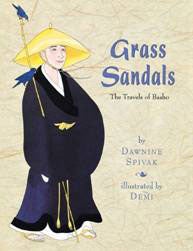 Lesson (pdf)
Materials (pdf)
Pictures of Yamadera PowerPoint (ppsx)
Incorporating Japanese Brush Painting PowerPoint (ppsx)
Hanging Scroll from Nihon Teacher's Resource PowerPoint (ppsx)
Objectives:
- Students will analyze haiku poems to find the rules for writing haiku poetry.
- Students will utilise the rules to write a haiku inspired by nature.
- Students will acquire about and form fivekanji characters.
- Students will embellish their haiku past creating a hanging scroll, gaining agreement of the Japanese tradition of combined literary and visual texts.
National Content Standards:
Reading and Writing
- Reading Standard ii:Determine primal ideas or themes of a text and analyze their development; summarize the cardinal supporting details and ideas.
- Reading Standard 5: Analyze the structure of texts, including how specific sentences, paragraphs, and larger portions of the text relate to each other and to the whole.
- Reading Standard half-dozen: Assess how point of view or purpose shapes the content and style of a text.
- Writing Standard 4: Produce articulate and coherent writing in which the development, system, and manner are appropriate to task, purpose, and audience.
- Language Standard 3: Apply knowledge of language to understand how language functions in different contexts, to brand effective choices for meaning or fashion, and to comprehend more fully when reading or listening.
Geography
- Geography Standard 4: Students know the concrete and human characteristics of places.
- Geography Standard 15: Students know how physical systems bear upon human systems.
Visual Arts
- Visual Arts Standard 1: Students understand and apply media, techniques, and processes.
- Visual Arts Standard 2: Students use knowledge of structures and functions.
- Visual Arts Standard 3: Students cull and evaluate a range of subject affair, symbols, and ideas.
- Visual Arts Standard iv: Students understand the visual arts in relation to history and cultures.
Plan for Assessment:
- Function ane: Students will synthesize a chart with the rules of haiku poetry. They will exist able to use the class-generated nautical chart to write and analyze their own haiku poetry.
- Part 2: Students will:
- Successfully form fivekanjicharacters.
- Paint appropriate illustrations to accompany haiku.
- Nowadays a terminal projection that exemplifies good craftsmanship.
A checklist for assessing students' work is provided.
Notes:
- This is a mini-unit written for the early simple grades only easily adjustable for older students. Part I, in which students complete a chart of rules for haiku, will take 3 to 4 20-infinitesimal form periods. The number of lessons needed will depend on the level of your students and their by experience with guided inquiry. Footstep the reading ofGrass Sandals accordingly over several days. For this interactive read-aloud lesson, the children should be on the carpet with easy view of the chart. They should be seated with predetermined discussion partners or teams.
- Function 2 builds on Function one, focusing on the visual arts and the Japanese tradition of combining texts and visuals to create works of fine art. This function of the unit will crave four class sessions of 40 to 60 minutes to complete.
- Matsuo Bashō, the chief character in the featured story,Grass Sandals: The Travels of Basho, is a famous Japanese poet who lived from 1644 to 1694, during the Edo period (1603-1868). In literary circles, he was a well-known teacher of a collaborative linked poetic form calledhaikai no renga. His talent for writing the introductory 5-7-v syllabic lines of ahaikai no renga popularized the fine art class of haiku. Despite the prohibition on travel, Bashō assumed the robes of a Buddhist monk and traveled by foot throughout Nippon, recording his thoughts in the class of both haiku and prose (haibun) for each of his journeys. Of the fivehaibun travel-diaries he published, his most famous,Oku no Hosomichi, is considered a canonical classic today. A few of his calligraphic works are preserved on hanging scrolls at several museums around Japan. Grass Sandals was inspired past and combines the places and spirit of several of Bashō's published travels.
Materials—Role 1:
- Grass Sandals: The Travels of Basho, past Dawnine Spivak
- Pictures of Yamadera PowerPoint(provided)
- Waraji grass sandals (Optional)
- Additional Basho haiku poems (Optional)
- Chart paper and markers; label the chart paper "Rules for Haiku"
- Haiku poems on pages 3 and 5 ofGrass Sandals written out large enough for children to meet easily from where they sit down
- Character for mountain (found on folio 3 ofGrass Sandals) written big enough for children to see easily from where they sit down
- Highlighter tape
- Figurer, LCD projector, screen
Implementation—Role 1:
Introduction
- Help children build or tap into their prior knowledge by discussing how books and poems have been records of history for thousands of years. Enquire students: Today when we see something we want to remember, nosotros can take a picture. But cameras are a adequately new invention. Before photography was invented, how could someone capture a visual image? (They could write about it or draw information technology.)
- Show the encompass ofGrass Sandals and explain that Bashō was a Japanese homo who lived over 300 years ago. Bashō went on many trips during his lifetime and frequently wrote about his journeys. Sometimes he wrote poems to capture what he was seeing. This book has three different kinds of writing: text, poems, andkanji.
- Show students thekanji for mountain and explain that it is Japanese writing. The symbol represents a mountain. Enquire students to look for all iii forms of writing as yous read the book.
- Introduce the blank nautical chart and allow students know they will be closely examining the poems in the book, looking for similarities. Introduce the termhaiku and allow the children know information technology is a specific form of poetry with specific rules. Explain that they will exist looking for the rules of haiku as yous read the poems in the volume. Let them know that all the poems in the book are haiku.
- Bear witness students thePictures of Yamadera PowerPoint and, if bachelor, bear witness students actual grass sandals. Bashō visited Yamadera and wrote near this identify in his travel diary,The Narrow Road to Oku. Hash out the pictures and sandals using "juicy"/descriptive words. (Note:Juicy words is a term Lucy Calkins, founder of the Teachers College Writing Project, uses for descriptive words.)
Instruction
- Offset to read the story. On pages ii and three, indicate out the text,kanji, and haiku poem. Read the poem a second time, asking the students to visualize the scene Bashō was describing. After the second reading, show the students the large print version of the same poem. Read the verse form a third time with the students as a shared reading. Enquire them to discuss with their partners or teams which words helped them visualize the scene. Give two to iii minutes for give-and-take. Have groups highlight or underline visualization words. Talk over what they discovered. Re-direct if necessary.
- Ask the students what else they notice about the poem. Give word time in teams and highlight the findings.
- Continue to read the volume. Finish at the 2d poem and repeat the poem, again asking the students to visualize the scene Bashō was describing. Pull out the large print version of the poem and repeat the process used on the first poem.
- Once both poems are highlighted, hang them adjacent and ask students to compare them. They should look for similarities and differences. Give three to 4 minutes of give-and-take fourth dimension in groups. Afterwards discussion, have the groups study their observations to the class.
- Based on the grade findings, ask students: What are the rules of haiku? Give word time. Nautical chart the class findings on the blank chart.
- Continue to read the volume, stopping at each verse form. Read each poem several times and take word teams make up one's mind if it follows the rules on the chart or not. Give a chance to add or decrease haiku rules from the chart with each poem. If children are having trouble discovering the rules of haiku, guide the word of the poems and bespeak out important features.
Conclusion
- Review the rules on the chart. Make sure the students included simple imagery using the senses—sight, touch, sound, aroma, taste, and/or feelings—and "strong" or "juicy" words. Metaphors and similes are not used. Haiku tell of one specific event or ascertainment and are written in the present tense. No time passes during haiku poems. Haiku also break punctuation and capitalization rules.
- After students take the sense of haiku, introduce the 5-7-5 pattern and 17 syllables. Add this to your nautical chart. Tell the children about the pattern and have them clap out the two big print poems.
- Review the chart and add or subtract any necessary rules.
- Take students write haiku poems inspired by thePictures of Yamadera PowerPoint or something they experience inspired by in nature (as Bashō did) during independent writing. If yous want to provide students with visuals for inspiration, a search fornature photography on Google Images (http://www.google.com/images) will plow upwardly hundreds of images you could projection via the computer. You could also have students cull a nature image from a walk outdoors.
- When students have finished writing, ask them to cocky-assess their poems past comparison them to the criteria on the chart and the 2 large-print poems.
- If you plan to use Function 2 of the mini-unit, read and edit students' poems. Depending upon age and ability of students, either the teacher can give-and-take procedure the poems on the calculator, selecting an appropriate font, or students tin rewrite the final poem by hand on adept quality painting newspaper.
Materials—Part 2:
- Grass Sandals: The Travels of Basho , by Dawnine Spivak
- Copies of Grass Sandals Classroom Museum Worksheet(provided) for all students
- Incorporating Japanese Brush Painting PowerPoint (provided)
- Hanging Scroll from Nippon Teacher's Resource PowerPoint(provided)
- Samples of haiku poetry (one source isThe Narrow Road to Oku by Matsuo Bashō)
- Japanese paintbrushes and thin, black tempera pigment (or brush pens and ink)
- Painting paper (12 in. x 36 in.) for all students
- Colored paper (twenty in. x 40 in.) for all students
- Rubber stamps, Styrofoam squares, or potatoes for border printing
- Water-based block-printing ink, metallic (gold or silvery) and ruddy, and brayers or roller-brushes
- Narrow newspaper strips for all students
- Cord or hangers and a wooden dowel for suspending the coil (for all students)
- Calculator, LCD projector, screen
Implementation—Part 2:
Introduction
- Review with students the combination ofkanjicharacters, pictures, and words used inGrass Sandals. Talk near the emotions evoked by looking at selected pages.
- Give an introduction tokanji. Use Section I of theIncorporating Japanese Brush Painting PowerPoint for visuals.
- Kanji are written characters that originated in China.
- Each character has a pregnant.
- Some simple characters are pictograms; that ways the grapheme is a articulate illustration of the discussion it represents. This is the case forki (tree),yama (mountain), andkawa (river) as introduced inGrass Sandals and studied in this lesson.
- Traditionally,kanjiare written and read in columns from summit to bottom and right to left. Today they are also written horizontally from left to right.
- When writing characters, stroke guild is of import.
- In that location are more than 50,000 characters. In Japan, elementary children learn 1006; in junior and senior high schoolhouse, students learn 939 more than.
- Kanji is one of iii character sets that make upward the written Japanese linguistic communication. The others arehiragana andkatakana.
Instruction
- Show Section II of theIncorporating Japanese Brush Painting PowerPoint, which shows akanji writing practise in a Japanese uncomplicated school classroom.
- Explain that, similar the Japanese students in the photos, the students volition now have a chance to learn and practice some of thekanji they saw inGrass Sandals.
- Explain the general rules of stroke society for writingkanji.
- Write from superlative to bottom and from left to right.
- Write horizontal strokes before vertical strokes. However, write horizontal strokes that "cut" through a character last.
- Write center vertical strokes first, left-side strokes second, and correct-side strokes tertiary.
- Write right-to-left diagonal strokes before diagonal strokes that go left-to-right.
- Write the left vertical-stroke of an enclosing stroke first. Write outside enclosing strokes earlier inside strokes. Always write lesser enclosing strokes last.
- End a stroke appropriately, with a 1) quick and straightstop mark; 2)flowing stroke that tapers at the end; or iii) a stroke that abruptlyhooks at the end. Use the character for tree inGrass Sandals for reference.
- Teach and practise fivekanji characters fromGrass Sandals: mount—yama, rain—ame, river—kawa,tree—ki, and friend—tomo. Students should employ the full general rules of stroke guild as they practice thekanji.
Guided Exercise
(encounter theHanging Curl from Japan Teacher's ResourcePowerPointfor a visual guide to the following implementation steps)
- Show examples of hanging scrolls (Section III of theIncorporating Japanese Brush Painting PowerPoint). Explain to students that Bashō'due south poetry was displayed in this fashion, and they will create a hanging roll for their haiku as a last production. Notation the asymmetric, yet unified, positioning of text and illustration.
- Have students take out the haiku they wrote at the end of Part 1 of the lesson. If they have not copied the final poem on practiced quality painting paper, have them exercise then.
- Using the example ofGrass Sandals,have students add together akanjigraphic symbol and a painted black-ink illustration that are related to the subject of their haiku. First have students do their blackness-ink illustration on a separate piece of paper. Encourage students to observe black-ink painting's range of color (from blackness to shades of gray) and variety of texture produced by different brushstrokes and amounts of pressure applied.
- Bear witness examples of the border designs of hanging scrolls (Section III of theIncorporating Japanese Castor Painting PowerPoint). Demonstrate the steps to print a edge forth the outer edge of the color newspaper using Styrofoam squares, safe stamps, or potato print. Practicing their printing techniques on a split up slice of paper first, accept students (one) carve patterns into their postage stamp; (two) ink the stamps; (iii) marshal the stamp at the edge of the paper; and (4) utilise pressure. Students should repeat prints evenly, one next to the other, to create a decorative edge for the hanging ringlet.
- Using a small piece of Styrofoam and red paint, have students create and impress an original chop mark (artist'southward seal) design on the painting paper.
- Attach the paper with text and illustration to the center of the bordered color paper. Adhere two narrow strips of paper from the meridian edge of the color newspaper to the top edge of the text and analogy to divide evenly into thirds the area in a higher place the text and illustration. Attach a cord or hanger on the top and a wooden dowel on the lesser to complete the gyre.
Determination
-
Accept students championship their works. Display last products in a classroom museum. Allow the students to walk around the room and employ theGrass Sandals Classroom Museum Worksheetto evaluate a classmate'southward work. As an alternative, the worksheet can be used as a rubric. Instead of check marks, score ane-4 to grade effectiveness
-
Invite other classes to view the illustrated haiku scrolls in the classroom museum.
-
Have small groups of students demonstrate thekanji characters they learned to attending students and give the visitors an opportunity to practice the techniques.
Extensions and Cantankerous-Curricular Ideas:
- Talk over syllables and have students clap out spelling words, friends' names, content words, etc.
- Social Studies: Help students map Bashō's journey on a map of Japan. Use Bashō'south travel stories as told inThe Narrow Route to Oku to learn about the geography of Japan. Encourage students to compare travel long ago to travel today. Compare the utilize of haiku in the past and photographs today to help illustrate and remember travel. After a field trip, accept students borrow Bashō's idea and write haiku of what they saw.
- Writing : Introducetanka andrenga poetry forms, which are predecessors of haiku.
- Tanka are 31-syllable (v-seven-5-7-seven) stanzas and often express passion and heartache. (See Poesy Talk lesson in thisTexts and Contexts curriculum collection.)
- Renga is collaborative verse in which writers linktanka poems written with one or more partners. Typicalrenga are 12, 18, or 36 stanzas of 5-vii-5 or 7-7. They include nature images, season words, and subjects of daily human life.
Resources and References:
Resource for Apply in Lesson
Spivak, Dawnine.Grass Sandals: The Travels of Basho. Demi, illustrator. New York: Atheneum, 1997.
References for Teacher Background
Burleson, Patricia. "The History and Artistry of Haiku."Japan Digest. Bloomington, IN: National Clearinghouse for United States – Nippon Studies, Indiana Academy, October 1998.
Donegan, Patricia.Haiku: Asian Arts & Crafts for Creative Kids. Boston: Tuttle Publishing, 2003.
Matsuo, Bashō. " Narrow Road to the Interior."Narrow Road to the Interior and Other Writings.Sam Hamill, translator. Boston: Shambhala Publications, Inc., 2000, pp. xxxii-36.
Matsuo, Bashō.The Narrow Road to Oku. Donald Keene, translator. Miyata Masayuki, illustrator. Tokyo: Kodansha International, 1996.
Sakade, Florence, ed.A Guide to Reading and Writing Japanese. Rutland, VT and Tokyo: Charles East. Tuttle Company, 1959.
Stroke Order. Wikipedia: The Free Encyclopedia.
The Program for Teaching Eastern asia at the University of Colorado gratefully acknowledges the support of theFreeman Foundation and Nihon Foundation Middle for Global Partnership in the development of Texts and Contexts: Teaching Japan Through Children's Literature.
Created 2010 Program for Educational activity East asia, Academy of Colorado.
Source: https://www.colorado.edu/ptea-curriculum/texts-and-contexts/grass-sandals-mini-unit-haiku-and-brush-painting
Post a Comment for "Asian Arts and Crafts for Creative Kids Haiku Pdf"